


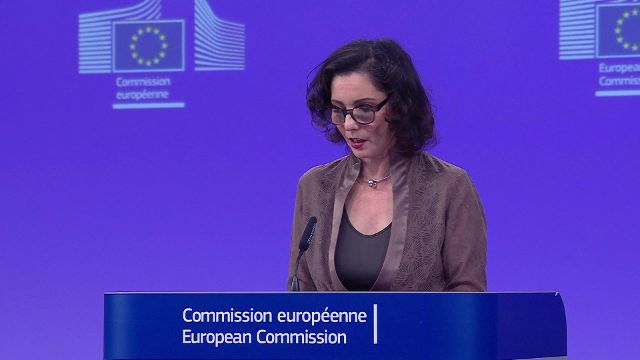
The European Commission unveiled its most ambitious gender equality programme on Thursday, timed to coincide with International Women's Day on Sunday, and presented to the press by the two commissioners responsible for it: Hadja Lahbib, overseeing equality, and Roxana Mînzatu, the executive vice-president for social rights. The occasion carried its own symbolism—three decades have passed since the UN's Beijing Platform for Action, still the benchmark against which global progress is measured. By that measure, the progress has been sobering.
"While others are taking steps backwards, the EU is moving forward, protecting the rights it has achieved, relaunching progress, and tackling resistance with courage and clarity," Commissioner Lahbib said at the Brussels launch. The defiant framing was deliberate: the strategy arrives as gender equality rolls back in parts of the world and as Brussels wrestles with the limits of its own ambitions at home.
The new strategy sets out 30 concrete measures across five broad areas. It builds directly on the Commission's Roadmap for Women's Rights, adopted in March 2025, and replaces the 2020–2025 Gender Equality Strategy, whose record—real but patchy—the document is candid about.
EU-wide survey data, gathered by Eurostat, the EU Agency for Fundamental Rights, and EIGE, shows that one in three women in the EU has experienced physical or sexual violence in adulthood. One in six has experienced sexual violence, including rape. One in five has faced domestic violence. And in the workplace, the harassment picture is particularly acute: more than four in ten young women in the EU have experienced sexual harassment at work, a figure Commissioner Lahbib cited explicitly in her remarks. "This must stop," she said, adding that the Commission was already consulting social partners on sexual harassment ahead of this year's Quality Jobs Act.
At the level of global leadership, the timeline is even more discouraging. "According to a report by UN Women," Commissioner Lahbib said on Thursday, "it would still take 130 years to achieve full equality between men and women in top leadership positions." She acknowledged a grim irony: women now lead the European Commission, the European Parliament, and EU diplomacy. The ceiling is cracking at the summit; the floors below remain stubbornly uneven. According to the EU's Gender Equality Index, maintained by the European Institute for Gender Equality (EIGE), the bloc is on course to take more than 60 years to close the gender equality gap entirely.
Perhaps the most celebrated legislative achievement cited by the strategy is the Pay Transparency Directive, adopted in May 2023. Equal pay for equal work has been enshrined in the EU Treaty since 1957—nearly seventy years of aspiration that, by Brussels's own reckoning, still has not been fully translated into practice. The directive is designed to make it legally enforceable. Separately, the Gender Balance on Boards Directive requires that, by 30 June 2026, the underrepresented sex must occupy 40 percent of non-executive director seats—or 33 percent of all director positions—at listed companies. The new strategy focuses less on adopting such measures than on ensuring they are actually implemented, a distinction that critics of EU law have long urged Brussels to take more seriously.

Germany's Women Lawyers Association has been among those pointing to the gap between proclamation and practice, arguing that gender mainstreaming—the embedding of equality considerations across policy areas—is "still far from meeting proclaimed intentions" in many areas of Commission policy. The association has called for a gender-specific approach in the commission's annual Rule of Law reports.
Among the most novel elements of the strategy is its treatment of technology as both a threat and a tool. The Commission intends to step up measures against cyberviolence—including sexually explicit deepfakes and so-called "deepnudes"—which overwhelmingly target women and girls.
The AI Act, now entering force, bans manipulative AI systems capable of facilitating gender-based violence and requires transparency around synthetic content, including deepfakes. The Digital Services Act requires online platforms to assess and mitigate systemic risks—including cyberbullying, stalking, and the non-consensual sharing of intimate images. In February, the Commission separately adopted an Action Plan Against Cyberbullying, targeted at the mental health of children and teenagers online.
Commissioner Lahbib also announced that the Commission would draft a recommendation on personal security in politics "in order to protect female candidates and elected representatives from online and offline threats." The announcement follows a sustained pattern of women in public life being subjected to coordinated harassment campaigns.
One area that marks a departure from previous cycles is women's health, which has been elevated to a dedicated focus for the first time. Commissioner Lahbib was direct about the longstanding failure of medical systems to serve women adequately. "Women are still underdiagnosed in heart disease, and too much medical research still ignores sex differences," she said. The Commission will launch a joint initiative with the World Health Organisation in 2026, focused on improving the quality and accessibility of women's healthcare, including for women with disabilities. New measures will address gaps in diagnosis and treatment, and a review of clinical trials will be conducted to ensure research populations better reflect women and other under-represented groups.
The Commission also announced "SHIELD," a new project to improve women's access to sexual and reproductive healthcare in crisis settings and to strengthen support for survivors of gender-based violence. The strategy further commits the Commission to responding to the European Citizens' Initiative known as "My Voice, My Choice"—the campaign for safe and legal abortion—between 2026 and 2027.
Last week the Commission confirmed that EU member states may use the European Social Fund Plus to fund abortion services for women travelling from other member states, though officials acknowledged the practical mechanisms for cross-border access would require further clarification by 2027.
Among the more striking expansions from earlier strategies is the explicit inclusion of men and boys—not as objects of reform, but as agents of change. The strategy commits to countering information manipulation and disinformation that can feed the radicalization of young men, an acknowledgement that gender equality policy cannot be addressed from one side of the equation alone.
Commissioner Lahbib was characteristically blunt in her remarks: "Men and boys are not bystanders in this change. They are partners." The strategy commits to reaching boys in the so-called HEAL fields—Health, Education, Administration, and Literacy—mirroring the longstanding focus on bringing girls into STEM subjects. Indeed, the "Girls Go STEM" initiative sets a target of bringing one million girls into STEM careers by 2028. A new Action Plan on Women in Research, Innovation, and Startups is to be launched with the aim to make Europe the premier destination for women in those fields by 2030.
The European Parliament, which adopted a preparatory report by 310 votes in favour, has urged the Commission to go further still. MEPs want a legislative proposal to recognize femicide—the killing of a woman or girl on grounds of her gender—as a distinct EU crime and a separate proposal establishing a consent-based definition of rape in EU law. Both remain aspirations rather than adopted law. The Parliament has also called on all EU member states that have not ratified the Istanbul Convention on preventing violence against women to do so.
On rape law specifically, Commissioner Lahbib offered a more cautious commitment: "We will update our mapping of rape laws across the EU to identify where further action, including legislation, may be needed to ensure that sex without consent is recognised as rape everywhere in Europe."
The Gender Equality Strategy sits alongside a parallel initiative. In October 2025 the Commission adopted the LGBTIQ+ Equality Strategy 2026–2030, extending the framework of protection and inclusion to LGBTIQ people across the Union. "Europe without LGBTQI people would not be Europe," Commissioner Lahbib said at its launch. Both strategies will be formally observed this weekend, on International Women's Day, 8 March.