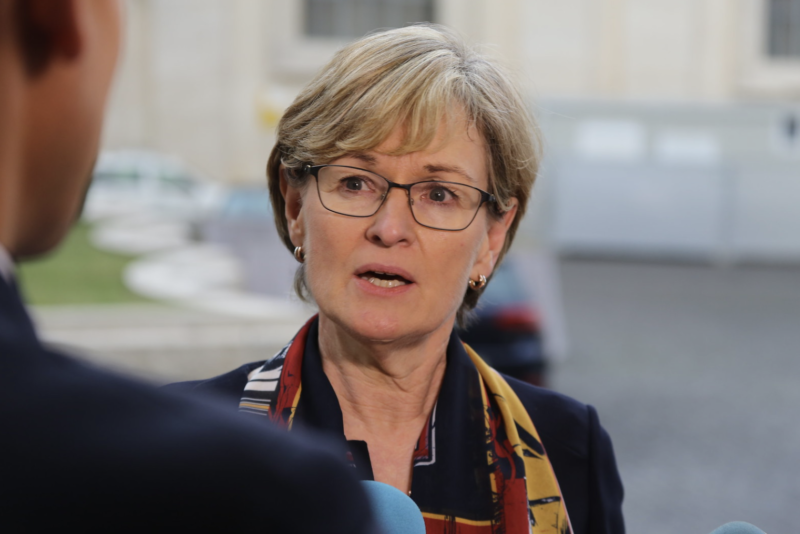


The European Commission has named Mairead McGuinness, the former Irish commissioner, as its Special Envoy for Freedom of Religion or Belief outside the EU, ending a vacancy that had grown into one of Brussels's embarrassing diplomatic silences.
The appointment, confirmed on Thursday, places the role under the remit of Magnus Brunner, the commissioner for internal affairs. McGuinness will report to Brunner and lead the EU's external engagement on religious persecution, working with governments, faith communities and civil society organisations beyond the bloc's borders.
The announcement closes a period in which the EU continued to present itself internationally as a champion of human rights while leaving its own dedicated envoy post conspicuously empty. The second von der Leyen Commission took office on 1 December 2024 and left the role vacant, a decision that quickly attracted criticism. In April 2025, the European Parliament's Intergroup on Freedom of Religion, Belief and Conscience wrote to Commission President Ursula von der Leyen and Commissioner Brunner calling for an urgent appointment, arguing that the worsening situation for believers and non-believers abroad required a timely and credible response.
Von der Leyen replied that she remained committed to the role, but the reassurance did little to quiet the critics. By October 2025, the bishops of the European Union, gathered under the body known as COMECE, wrote to her again, warning that in a world marked by instability the EU needed a visible instrument to defend religious freedom as part of its external action.
A further complication emerged in December 2025, when Humanists International published a letter signed by 18 cross-party MEPs warning that the next envoy should not use the mandate in ways that undermine the rights of women, LGBTIQ+ people or non-believers — adding a question of scope and universality to the simpler demand for speed.
The previous holder of the post was Frans van Daele, a Belgian diplomat. Since the end of the first EU Special Envoy Jan Figel's full mandate in November 2019, the Commission had appointed only two special envoys for short periods: Christos Stylianides of Cyprus, who left after four months, and van Daele, who served for two years.
McGuinness brings unusual breadth to the job. She served as a member of the European Parliament from 2004 to 2020, sitting with the European People's Party, and as first vice-president of the Parliament from 2017 to 2020, with responsibility for implementing Article 17 of the Treaty on the Functioning of the European Union (TFEU), which governs dialogue between EU institutions and churches, religious associations and non-confessional organisations. She subsequently served as European Commissioner for Financial Services, Financial Stability and Capital Markets Union from 2020 to 2024.
McGuinness, a former broadcaster, had hoped to run for the Irish presidency last year but was forced to withdraw from the race due to ill health. She later revealed that the cause was a severe bout of post-viral fatigue syndrome.
The Catholic bishops' body COMECE welcomed the appointment but reiterated its call to "endow the position, without further delay, with a strong mandate and to provide it with adequate human and financial resources," a point that advocacy groups have long argued is the difference between the role carrying real weight and remaining largely symbolic.
Her brief will include raising awareness of religious discrimination, protecting persecuted minorities through education and dialogue, and supporting efforts to counter radicalisation and extremism. Ireland's foreign minister Helen McEntee, whose country holds the EU's rotating presidency, said she looked forward to working with McGuinness, noting that the EU guidelines on freedom of religion or belief that will frame the envoy's work were first agreed during a previous Irish presidency.